Crispy Potatoes with Green Sauce
Boil the centers, rough up the edges, and use a handful of parsley for a sauce sharp enough to wake up a pan of roast potatoes.
8 min read
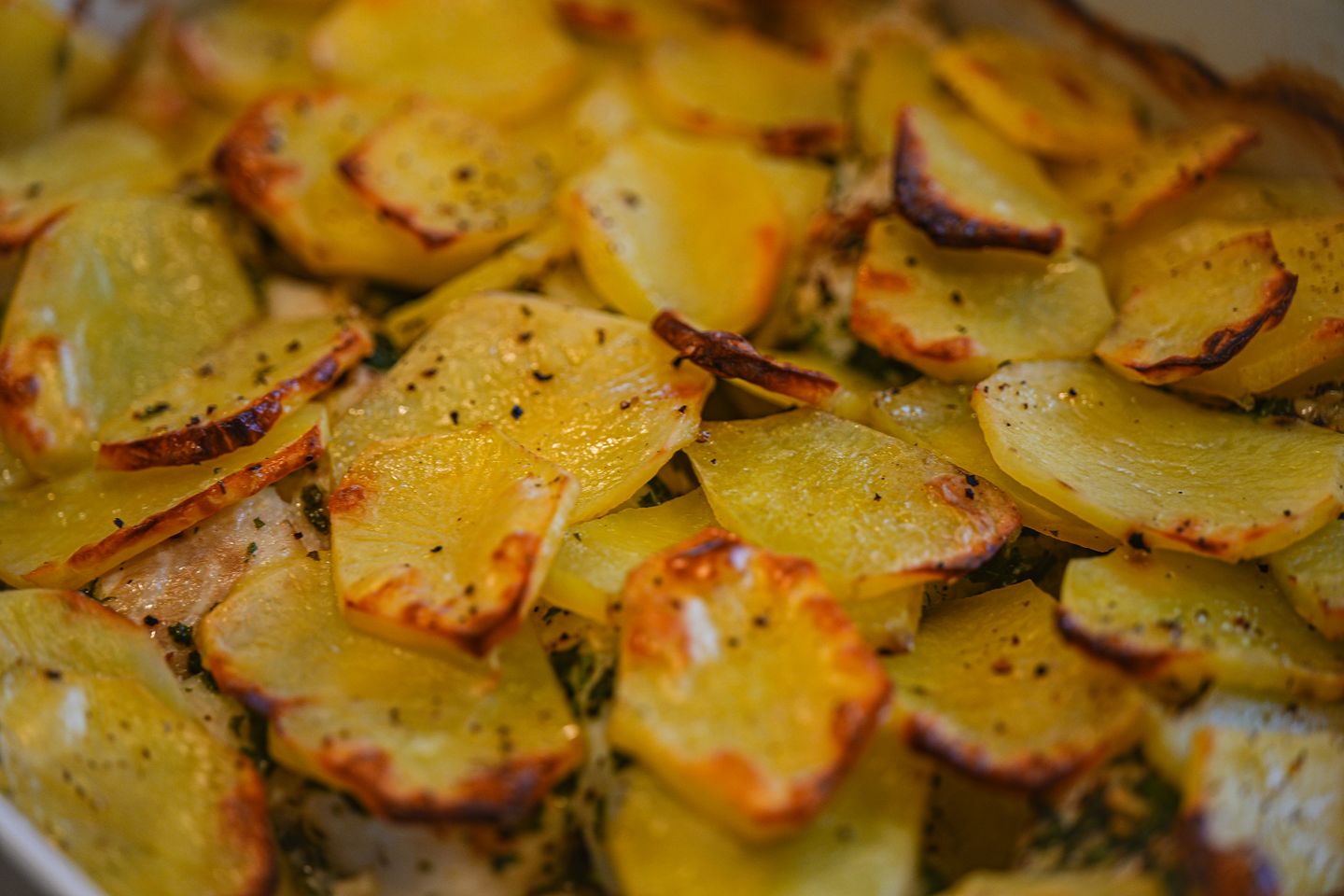
A crisp roast potato has two quite different jobs to do. The middle should be ready to eat when the outside is as dark as you like it. Then, when it reaches the table, the crust has to survive long enough to give way under a fork. You can arrange both jobs around a saucepan and a sheet pan. Boil the pieces until their edges are soft enough to scuff, let the steam escape, and roast them with enough bare metal around each piece to dry the outside. The parsley sauce can wait in a bowl while all that happens.
Serve the potatoes with a fried egg, next to fish, or just as they are with salad. People often put a lot of effort into making one crisp side on the tray. Turning the pieces and giving them some more time is what takes the other surfaces from dry to brittle. Leave a few cut pieces slightly larger than the rest if you enjoy the difference between a soft, mealy center and a smaller bit that is nearly all crust. As long as the two sizes are within reason, both belong on the table.
The groceries and the pans
For four side portions, use 900 grams of potatoes, 3 tablespoons of neutral cooking oil, and fine salt. Choose potatoes sold as floury or all-purpose. A Russet usually produces a rougher edge and may shed more crumbs when shaken. A Yukon Gold or similar all-purpose potato generally holds together more easily. For the sauce, use 30 grams of flat-leaf parsley with the tender stems, 1 tablespoon capers, 1 small garlic clove, 1 tablespoon red wine vinegar, and 4 tablespoons extra-virgin olive oil. A second spoonful of vinegar is useful to keep in reserve. Coarsely ground pepper is optional.
Set out a saucepan large enough to cover the potatoes with water and a large rimmed metal sheet. If you are working with a half-size sheet and the pieces will not fit comfortably, use two. Leave the glass baking dish for something else. Its tall walls keep steam closer to the food and its heat transfer differs from that of a thin metal pan. A well-used aluminum sheet with a few stains will work. Avoid a tray that buckles badly, especially if you plan to heat it empty. You can get a good crust on a cold pan, too.
Scrub the potatoes and peel them if you want the roughest crust. A thin-skinned yellow potato is pleasant with its skin, but only its cut sides will rough up. Remove any sprouts or green patches generously. If a potato is extensively green, very sprouted, or bitter, discard it. Cut the potatoes into pieces roughly 4 centimeters across. Aim for two or three flat sides per piece. A small potato can be quartered. For a large oval one, split it lengthwise, cut each half into thirds, and then halve any especially bulky wedges. A broad face helps the potatoes sit securely when you turn them.
Boil until the outside gives
Set the potatoes in the saucepan, cover them with cold water by about 2 centimeters, and add enough salt to season the water lightly. Heating the pieces with the water gives the centers time to catch up with the outsides. Bring it to a boil, then reduce the heat so the water bubbles gently. A busy rolling boil knocks the corners off before you can judge how much they have softened. Heat the oven to 220°C or 425°F while the water comes up.
After about 8 minutes at a simmer, lift a piece onto a plate and try the tip of a table knife. The outside should yield easily. The center should offer a little resistance, like a potato that needs one more minute before you would drain it for a salad. Try again a minute or two later if the knife seems to meet a hard wall. If you use a floury variety and see the corners already breaking apart in the water, drain the potatoes at once. Retain any small pieces that survive. They often become the cook's snack after roasting.
Drain well and leave the colander standing over the empty pan for a couple of minutes so the steam can escape. Then return the pieces to the dry saucepan, cover it, and give it a short, controlled shake. Take the lid off and look. A chalky film with little crumbs stuck around the cuts is enough. If the surface is still shiny and smooth, shake again. Floury potatoes need a gentle hand. If you went too far with a few pieces, leave the crumbs with the rest and use a spatula to move them to the sheet. Small clusters take on color sooner than the full pieces.
Spread them far enough apart
Toss the potatoes with the neutral oil and a pinch of salt. Some of the roughed-up material will stick to the saucepan. Scrape it out with a rubber spatula and put it on the tray where it can crisp. Set as many pieces as possible on a broad cut surface. If the sheet has enough room, aim for a finger's width between pieces. A full tray can roast, but where the potatoes touch, the two surfaces will steam and stick together. A piece that sits on its round side will be slower to build a crust where it makes little contact.
Roast on a middle rack for around 20 minutes before trying to turn a piece. Take out the whole tray and set it on a heatproof surface so you can see the undersides. Slide a thin spatula under a potato. If the face is light and sticks firmly, give it more time. Once the surface has browned enough to release, turn it onto another broad face. Set a timer for 10 minutes and check again. Expect about 35 to 50 minutes in total, with the largest pieces often needing the upper end of that range. Look at the pan more often during the last stretch. Any loose crumbs have much less moisture than the large pieces and will darken sooner.
A pan of stubbornly pale potatoes can often be improved. First check whether they are still giving off clouds of steam. If they are, spread them out or transfer some to a second sheet. If there is plenty of room and the tray feels very dry, drizzle a teaspoon of oil over the broad faces and turn them again. An oven that takes a long time to recover after opening may need a few extra minutes. Keep the temperature steady and check through the window when you can. The sound changes as the crust dries. Early on you may hear a lively sizzle. Near the end the potatoes sit more quietly, and moving one against the sheet produces a short scraping sound.
Chop the sauce while the potatoes roast
Rinse the parsley and shake it dry. Chop the leaves and tender stems until the pieces are small enough to cling to the point of a spoon. A few coarser leaves are welcome. Rinse very salty capers if needed, then chop them separately. Grate the garlic into a bowl or chop it to a paste with a small pinch of salt. Pour the vinegar over the garlic and let it sit while you finish chopping. Stir in the parsley, capers, and olive oil. Taste the sauce on a corner of bread or on a scrap of potato. A bite of starch is a better guide than a spoonful of oil and vinegar on its own.
Spoonable is the aim. The green pieces should settle into a mound and leave a little liquid behind. Too much oil makes the sauce pool on the plate. Add another tablespoon of parsley if you chopped extra, or stop short of pouring in the last of the oil. If the vinegar seems shy, use the spoon you kept in reserve. Capers supply both brine and a firm little bite. If you substitute green olives, use a few more pieces and chop them slightly smaller. A squeeze of lemon can replace some of the vinegar if you want a brighter finish.
A handful of fresh herbs can carry flavors other than parsley. A little mint is particularly good with a plate that includes peas. Use a few leaves at first, since it can quickly become the dominant flavor. Chives can take the edge off raw garlic in a sauce meant to sit next to an egg. If someone wants a milder sauce, leave the garlic out and keep the capers whole so that the salty bite is easy to avoid. Put lemon wedges and salt beside the dish and let people finish their own portions.
Carry two dishes to the table
Move the hot potatoes to a plate without piling them too high. Give them a small pinch of salt while the surfaces are still glistening. Serve the sauce separately or spoon it onto an exposed part of the plate. Each person can drag the fresh cut edge of a potato through the green sauce and leave the crackliest bits dry. If a serving has to wait a few minutes, spread it out on the tray and leave it uncovered. A bowl with a lid keeps warmth in by trapping steam, which is exactly what the crust has spent all that time losing.
Refrigerate leftovers promptly. Store the potatoes and sauce separately and discard any leftover herb sauce after four days at most because it contains raw garlic and herbs in oil. To reheat the potatoes, put them back on a metal tray in a hot oven and leave them until the outsides are dry again. They can also be flattened a little and reheated in a skillet with a thin coat of oil. That creates a new flat face and a different kind of crust, useful under an egg the following morning. A spoon of fresh yogurt with parsley and lemon is good alongside if the green sauce is already gone.