Quinoa Stuffed Squash
Roast small squash until the walls are tender, then fill them with a lemony quinoa pilaf, toasted walnuts, and bits of dried apricot.
8 min read
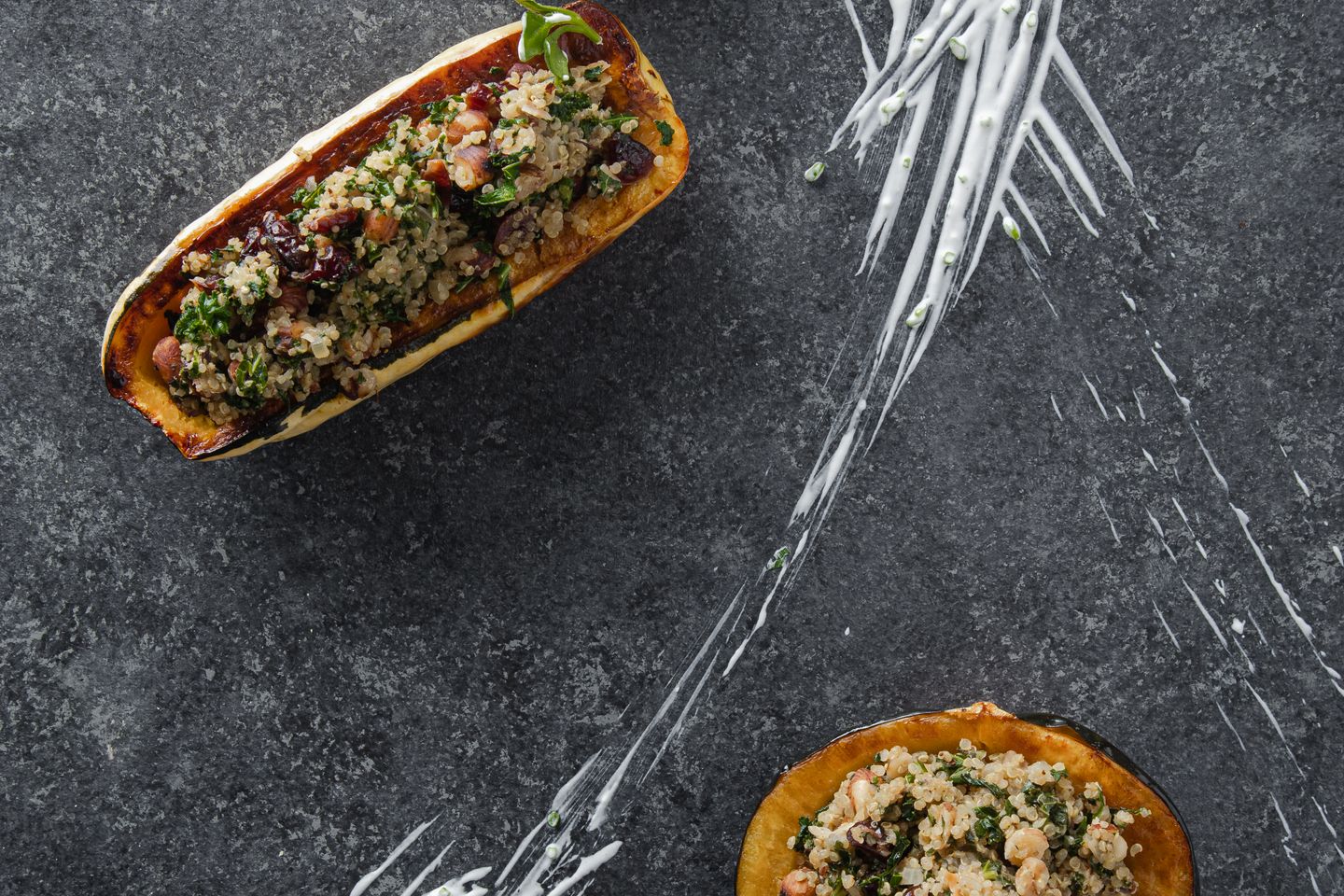
A stuffed squash asks for two kinds of tenderness. The shell must be soft enough to scrape with a fork, even close to the skin. The filling needs separate grains and a few things to chew between them. A little oven time together at the end brings the two into the same dish. Most of the cooking happens apart, while you can judge each on its own.
Quinoa works here because a relatively small portion spreads among the walls of the squash. It can carry some of the shallot and lemon into every spoonful without making the filling feel heavy. Apricots soften in the cooking water and hold a little sweetness in concentrated pieces. Walnuts stay outside the pot until the pilaf has had time to steam dry. By the time you put the halves on plates, some will be toasted at the surface and a few will be tucked among the grains.
Ingredients for four squash halves
- 2 small acorn squash, about 1 1/4 pounds each
- 3 tablespoons olive oil, divided
- 1/2 teaspoon fine sea salt, divided, plus more to taste
- 3/4 cup dry white quinoa
- 1 small shallot, finely diced
- 1 1/4 cups water or unsalted vegetable broth
- 1/3 cup dried apricots, about 6, diced
- 1/3 cup walnuts
- 1 tablespoon lemon juice and 1 teaspoon finely grated lemon zest
- 1/4 cup chopped flat-leaf parsley
- Freshly ground black pepper
Use a rimmed baking sheet and a small saucepan with a tight-fitting lid. Acorn squash varies quite a bit in shape. Look for two of similar size so the halves will cook in about the same amount of time. If you buy squash with very shallow seed cavities, expect some filling to remain. Serve the extra in a little bowl, where it is easy for diners to add after they have scraped away part of the squash. Deep cavities have the opposite problem and can use the full amount. The tops will crisp better if the quinoa sits in a loosely piled mound.
White quinoa has a mild flavor that lets the apricot and parsley stand out. Red or mixed quinoa can also work. It often keeps a little more firmness after cooking. Read the timing instructions for your particular package and check the texture near the indicated time. Dried apricots should bend a little when squeezed. Very hard, dry fruit can be soaked in hot water for ten minutes, then drained and chopped before use. Dice the fruit small enough that the pieces can scatter through the pilaf.
Roast the squash with the open faces down
Heat the oven to 425°F (220°C). Scrub the squash and dry it. Set one on a board so it rests on its broadest surface, with a folded towel beneath the board if it tends to slide. Hold the squash steady and cut lengthwise through the base toward the stem with a large sharp knife. If you cannot cut through the tough stem without pushing hard, stop the cut before the stem, cut from the other side, and pull the two halves apart with your hands. If the squash remains too hard to handle comfortably, use smaller squash or choose one that a produce counter can halve for you.
Use a spoon to scrape out the seeds and loose fibers. The cavity needn't be completely smooth. It helps to remove a strand that might pull out with the first bite, while some soft flesh left attached is useful. Rub the exposed squash with about 1 tablespoon oil in total and sprinkle the surfaces with a generous pinch of the measured salt. Put the halves cut-side down on the sheet and roast for 25 to 35 minutes. Start checking the smaller halves first. A fork or thin knife should go easily through the flesh beside the stem.
Turn the halves upright after they are tender. The cut surfaces should have colored where they touched the sheet. If a particularly large squash has pale, firm spots around the cavity, return it to the oven cut-side up until those spots have softened. The skin may be edible when thin and tender, although diners can leave a tough section of skin on the plate. What matters for the recipe is that the flesh lifts away easily and the cooked half still holds enough shape to contain the filling.
Cook the quinoa while the squash roasts
Rinse the quinoa in a fine sieve under cold water. Swish it around with a finger and allow it to drain thoroughly. Heat 1 tablespoon olive oil in the saucepan over medium-low heat and add the diced shallot. Cook for 3 to 5 minutes, stirring occasionally, until it softens and smells sweet. Add the drained quinoa and stir for a minute. The grains should move easily in the oil. If they begin to stick together, stop and add the cooking liquid.
Add the water or broth, the remaining measured salt, and the diced apricots. Bring the liquid to a boil, then cover the pot and reduce the heat. Let it simmer gently for about 15 minutes. Check for moisture before removing the pan from the heat. Tip the pan slightly and look at one edge. If there is still a substantial amount of liquid, cover and cook another minute or two. Once the water is absorbed, turn off the heat and leave the lid on for 5 minutes. The rest lets moisture distribute across the grains.
Uncover and fluff the quinoa with a fork. The little pale spiral on a cooked grain should have become visible, and the center should yield when you bite it. If the grains are still firm and dry, sprinkle on two or three tablespoons of hot water, return the lid, and give them a few minutes over very low heat. If the quinoa looks wet after the rest, spread it onto a wide plate for a minute or two to let steam escape before seasoning. A soft, slightly uneven pilaf is fine as long as it will heap on a spoon.
Toast the walnuts in a dry skillet over medium-low heat while the quinoa cooks. Stir for 4 to 6 minutes, until the pieces smell toasted and take on a little color, then pour them onto a plate. Chop them coarsely when cool. If the filling needs to avoid walnuts, toasted pumpkin seeds give a different sort of crunch and can be added the same way. A handful of seeds takes less time to toast. Move them off the heat when a few begin to pop and puff.
Fill and return the squash to the oven
Fold most of the walnuts, the lemon juice and zest, parsley, black pepper, and the final tablespoon of oil into the fluffed quinoa. Taste a small forkful with a piece of squash. The filling can handle a little more salt or lemon than it seems to need alone, since the squash will soften the seasoning in each bite. Add any extra seasoning before filling the shells so it spreads evenly. If the squash is particularly sweet, add a few more drops of lemon.
Set the squash cut-side up on the sheet. If one rocks, use a little folded piece of foil underneath to steady it. Spoon the quinoa into the cavities without compressing it and sprinkle with the reserved walnuts. Bake for another 6 to 8 minutes, just until the filling is hot and a few grains at the top turn slightly crisp. Shorten this last baking time if you had to dry the quinoa considerably after cooking. A very dry pilaf needs only enough time to rewarm in the squash, not a second chance to lose moisture.
Bring the halves to the table with their cut edges exposed. Serve with a fork and spoon so diners can take both the filling and a little of the wall. A spoonful of plain yogurt or a little crumbled feta on the side is welcome if you want something cool to accompany the walnuts and squash. The squash may also go beside a large leafy salad. Keep that salad on a different plate when it is dressed generously, since vinegar and oil will run into the filling if both share a shallow dish.
For a buffet, quarter the roasted squash before filling it and prop each wedge against its neighbor on the baking sheet. Spoon a smaller mound onto each piece and serve with a wide spatula. This makes the portions easier to lift than halves cut through the cooked filling at the table.
Serve at different times from the same batch
If two people are eating early and two later, warm only the halves you need in the last baking step. Refrigerate the cooked squash and quinoa promptly, preferably in separate covered containers. Reheat the remaining squash and filling before assembling and adding the nuts. That way the pilaf still has a dry top to crisp. If the refrigerated quinoa has become firm, sprinkle it with a little water before warming and fluff it again afterward. Add a little fresh parsley when you are ready to serve.
Any leftover filling can be turned into a cold quinoa salad. Loosen it with a teaspoon of lemon juice and a little olive oil. Add a handful of chopped celery and an extra spoonful of parsley so the salad has a brighter texture. Leftover plain squash can be spooned out of its shell and folded into a warm bowl of quinoa in pieces. In that case use a broad spoon and stir once. After all the effort of roasting it until tender, some of the pieces are still worth keeping intact.